
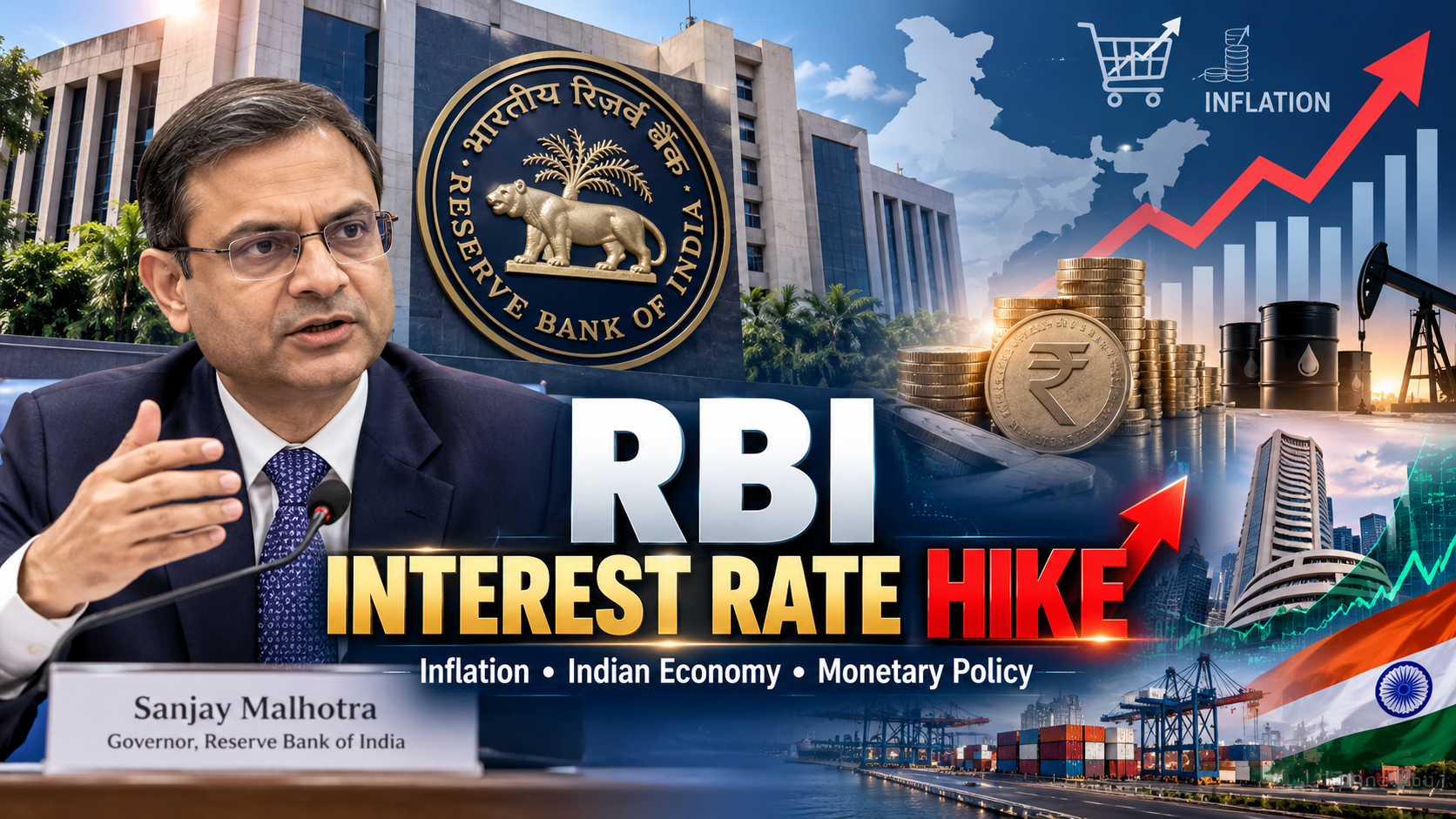
The Reserve Bank of India (RBI) surprised few but reassured many when its Monetary Policy Committee (MPC) unanimously decided to keep the policy repo rate unchanged at 5.25% while retaining its neutral policy stance. On the surface, the decision appears straightforward. However, Governor Sanjay Malhotra’s monetary policy statement reveals a complex balancing act between supporting economic growth and containing emerging inflationary pressures.
The decision comes at a time when India’s economy remains one of the fastest-growing major economies in the world, yet faces increasing uncertainty from global geopolitical tensions, volatile energy prices, and financial market instability. The RBI’s message was clear: this is not the time for aggressive policy changes.
A Changing Global Environment
A central theme of Governor Malhotra’s speech was the deterioration in the global economic environment. The ongoing conflict in West Asia has significantly increased uncertainty in commodity and financial markets. Crude oil prices have risen sharply, supply chains face renewed disruptions, and global growth prospects have weakened. These developments have important implications for India, which remains a major importer of crude oil.
For policymakers, higher oil prices create a difficult challenge. They increase transportation and production costs, eventually feeding into consumer inflation. At the same time, they reduce household purchasing power and can slow economic activity.
In such circumstances, cutting interest rates further could risk fuelling inflation, while raising rates could unnecessarily weaken growth. The RBI therefore chose to remain on hold and assess how these external shocks evolve over the coming months.
Inflation Risks Have Increased
Perhaps the most important reason behind the policy pause is the RBI’s assessment that inflation risks have moved to the upside.
Governor Malhotra acknowledged that while inflation remains within the RBI’s tolerance band, several factors could push prices higher in the coming quarters. Rising crude oil prices, uncertainty surrounding the monsoon, and global supply disruptions all threaten to increase inflationary pressures.
The RBI reportedly revised its inflation outlook upward, indicating that policymakers are becoming more cautious about price stability. Inflation management remains the primary mandate of the MPC, and any signs of persistent price pressures naturally reduce the central bank’s willingness to cut rates further.
From a policy perspective, maintaining the repo rate at 5.25% allows the RBI to preserve its anti-inflation credibility while avoiding unnecessary tightening.
Growth Remains Strong but Faces Headwinds
India’s growth story remains fundamentally strong. Domestic demand continues to support economic activity, government capital expenditure remains elevated, and private investment has gradually improved. However, the RBI has become slightly less optimistic about the near-term growth outlook.
The central bank revised its GDP growth forecast lower compared with earlier projections, reflecting concerns about external demand, global uncertainty, and the potential impact of higher energy costs on domestic consumption.
This growth-inflation trade-off explains why the RBI opted for a pause rather than a rate hike. Economic activity remains healthy enough that additional monetary stimulus is unnecessary, but downside risks to growth remain significant enough that tighter policy would be premature.
In essence, the RBI believes the current interest rate setting remains appropriate for the economic conditions facing India today.
The Rupee Also Matters
Another major factor influencing the MPC’s decision is the performance of the Indian rupee.
The rupee has faced pressure in recent months due to rising oil prices, global capital outflows, and increased geopolitical uncertainty. According to reports, the currency has weakened considerably during 2026, creating additional inflation risks through higher import costs.
Lower interest rates could have further weakened the currency by reducing the attractiveness of Indian financial assets for global investors. Instead, the RBI chose to maintain rates and simultaneously announced measures aimed at attracting foreign capital and supporting the rupee. These initiatives were welcomed by financial markets and contributed to an immediate strengthening of the currency following the announcement.
The decision highlights an important reality of modern monetary policy: central banks must manage not only inflation and growth but also financial stability and currency dynamics.
Why the Neutral Stance Was Retained
Equally significant was the MPC’s decision to retain a neutral policy stance.
A neutral stance provides maximum flexibility. It signals that future policy decisions will depend entirely on incoming economic data rather than a predetermined path. If inflation accelerates further, the RBI retains the option to tighten policy. If growth weakens sharply, rate cuts remain possible.
Given the extraordinary uncertainty surrounding global oil markets, geopolitical developments, and weather-related risks, flexibility has become a valuable policy asset.
The RBI’s communication suggests that policymakers prefer a “wait-and-watch” approach rather than making large policy adjustments based on temporary shocks.
The Bigger Policy Message
The June 2026 policy decision reflects a central bank prioritizing stability over activism.
India currently faces a rare combination of moderate inflation, solid growth, external uncertainty, and currency pressures. Under such circumstances, maintaining the repo rate at 5.25% represents a pragmatic middle path.
Governor Malhotra’s message was that India’s economic fundamentals remain resilient, but the global environment has become significantly more uncertain. Rather than reacting aggressively to short-term developments, the RBI has chosen patience.
For households, businesses, and investors, the immediate implication is clear: borrowing costs are unlikely to change dramatically in the near future. For policymakers, however, the challenge remains substantial. If oil prices continue rising or inflation surprises on the upside, the RBI may eventually need to consider tighter monetary policy. Conversely, a deterioration in global growth could reopen the door to future rate cuts.
For now, the RBI has decided that the best course of action is to stand still—and sometimes in monetary policy, standing still is the most strategic move of all.


Leave a Reply