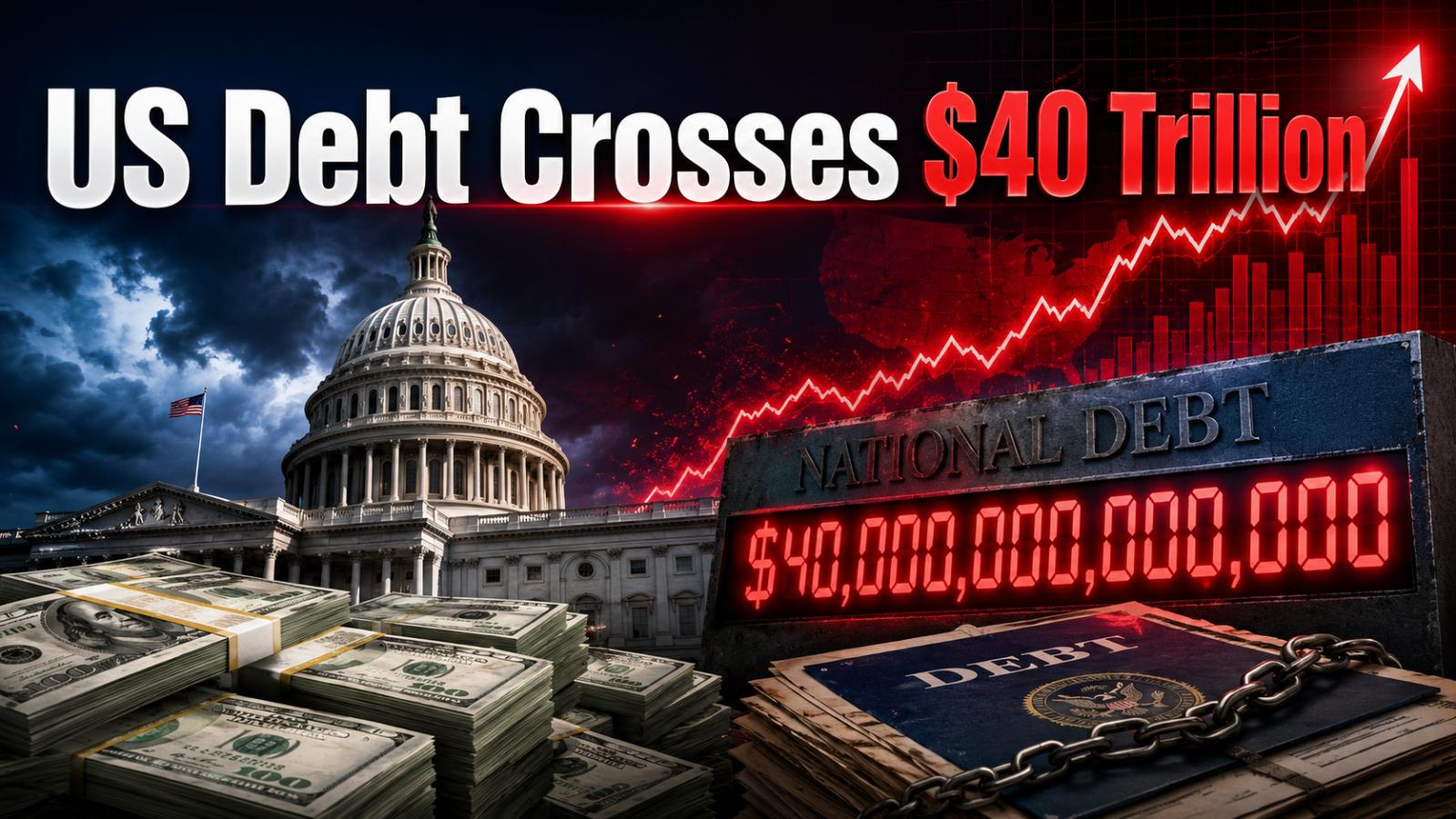
The gross U.S. national debt crossed $40 trillion this week, according to Treasury Department figures tracked in the “Debt to the Penny” dataset a threshold that arrived faster than official forecasters had expected. The Congressional Budget Office had penciled in $39.4 trillion for the full year; instead, the country blew past $40 trillion by mid-August, driven in part by tariff-related revenue disruptions after the Supreme Court invalidated a key piece of the Trump administration’s tariff program, forcing the Treasury to scramble for alternative funding. The round number is symbolic more than substantive debt does not become dangerous at a particular digit but it has reignited a debate that Washington has mostly declined to have: what happens when a global superpower keeps borrowing faster than its economy grows, and who ultimately bears the cost.

A Bill That’s Coming Due in Real Time
Of the $40 trillion headline figure, roughly $32 trillion is debt held by the public the portion economists watch most closely because it represents borrowing from actual outside investors rather than transfers between government accounts like the Social Security trust fund. That distinction matters, but it doesn’t change the trajectory: publicly held debt is now approaching the size of the entire U.S. economy, and the Congressional Budget Office projects the debt-to-GDP ratio will climb from about 101% this year to 120% by 2036, surpassing the post-World War II record of roughly 106%.
The most immediate economic consequence is showing up in the federal budget itself. Net interest payments are projected to exceed $1 trillion in 2026 more than the government spends on any mandatory program except Social Security and Medicare, and now rivaling or exceeding total defense outlays. That is money that funds nothing: no roads, no research, no military hardware, just the cost of servicing past borrowing. As that interest bill grows, it mechanically squeezes the room lawmakers have to fund anything else without raising taxes, cutting other programs, or borrowing still more.
The second channel runs through interest rates. Treasury yields, particularly the 10-year note, serve as a benchmark for mortgages, auto loans, corporate bonds and municipal financing. If investors grow less confident in Washington’s fiscal trajectory, they may demand higher yields to keep holding U.S. debt, and that repricing filters directly into household borrowing costs a dynamic fiscal analysts at organizations like the Peterson Foundation have flagged as the most tangible way ordinary Americans will feel a debt that, technically, they don’t personally owe. A related risk is inflation: if markets begin to suspect that policymakers will eventually lean on the Federal Reserve to effectively monetize the debt rather than confront it through taxes or spending cuts, that expectation alone can put upward pressure on prices well before any such policy is enacted.
There is also a slower-moving structural cost. Economists generally view heavy public borrowing as a potential drag on private investment the classic “crowding out” effect, where government demand for capital competes with private borrowers for the same pool of savings, and where a debt overhang limits the government’s room to maneuver in the next recession or financial shock.
The United States is spending billions of dollars on the ongoing Iran war, adding further pressure to an already strained federal budget. Military operations, weapons, fuel and troop deployments are increasing government expenses, while the conflict’s prolonged nature could push costs even higher. This adds another challenge to America’s growing $40 trillion debt burden.
Bipartisan Drift, No Off-Ramp
What makes this debt run different from prior fiscal alarms is the near-total absence of political urgency to address it. Debt has doubled since January 2017, rising from roughly $20 trillion to $40 trillion across two Trump terms and the intervening Biden administration a bipartisan accumulation driven by tax cuts, pandemic-era spending, and, more recently, a Trump-era tax-and-spending package projected to add trillions more to deficits over the coming decade, on top of supplemental war-related funding requests tied to conflicts such as the Iran strikes. Neither party has offered a credible plan to close the structural gap between what the government collects in revenue and what it spends on an aging population’s pensions and health care.
The Congressional Budget Office’s own diagnosis is blunt: putting the debt on a sustainable path requires some combination of slower spending growth and higher revenue in other words, either benefit cuts, tax increases, or both, applied at a scale well beyond what either party has proposed. In the meantime, the Treasury has leaned on technical tools like expanded debt buybacks to keep the bond market functioning smoothly, a sign of active crisis management rather than structural reform.
Politically, this may be starting to matter at the ballot box. Fiscal watchdogs argue that voters are increasingly linking the abstract debt figure to concrete pain points like elevated mortgage rates, and that this connection could shape how the debt debate plays out in upcoming midterm elections even though neither party has staked its campaign primarily on fiscal restraint.
A Debt-Fueled Order Under Strain
Roughly a quarter of publicly held U.S. debt around $9.3–9.5 trillion is held by foreign investors, and the composition of that ownership has been quietly shifting in ways that carry strategic weight. Japan remains the largest single foreign holder, at roughly $1.2 trillion, followed by the United Kingdom at close to $900–940 billion. China’s holdings, by contrast, have fallen both in dollar terms and as a share of total foreign ownership, continuing a multi-year trend as Beijing diversifies its reserves amid ongoing trade tensions and a broader strategic rivalry with Washington. Financial centers such as the Cayman Islands, Belgium, Luxembourg and Ireland also rank among the largest “holders” on paper, though much of that reflects custodial accounts for funds and corporations rather than sovereign strategy.
This matters geopolitically on two levels. First, it underscores the deep asymmetry of the postwar dollar-based financial system: the world’s central banks and sovereign wealth funds continue to recycle trade surpluses into U.S. Treasuries because there is still no comparably deep, liquid, and trusted alternative asset a structural advantage sometimes called America’s “exorbitant privilege.” That privilege is precisely what allows Washington to run deficits far larger, relative to the size of its economy, than most other major economies could sustain without a currency crisis.
Second, and in tension with the first point, the steady erosion of China’s Treasury stake is one small piece of a broader, slow-moving effort by geopolitical rivals to reduce dependence on dollar-denominated assets whether through gold accumulation, bilateral trade settlement in local currencies, or alternative payment infrastructure. None of this threatens the dollar’s dominance in the near term; foreign appetite for Treasuries has in fact stayed resilient in aggregate, with private investors and a wider set of countries stepping in even as official Chinese buying recedes. But it does mean the United States is financing an ever-larger debt load with a shrinking margin of unconditional foreign goodwill, at precisely the moment its own fiscal trajectory is becoming harder to defend on the merits. A debt that size, sustained by geopolitical rivals and allies alike choosing to keep lending, is as much a statement about the absence of alternatives as it is a vote of confidence and that is a foundation few in Washington seem eager to stress-test.
Sources: U.S. Department of the Treasury, Fiscal Data


Leave a Reply