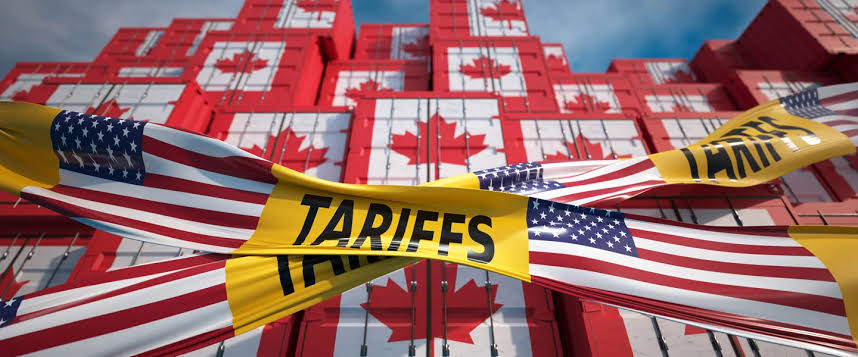
The United States announced a new 50% tariff on a significant range of Canadian goods, marking one of the most aggressive escalations in North American trade relations in decades. The tariffs were signed under three presidential proclamations invoking Section 338 of the Trade Act of 1930, an authority that had lain largely dormant for nearly a century until now. The new duties exclude energy products, potash, fish and critical minerals, but they capture a wide swath of goods — including autos, alcohol and dairy products — that had previously been shielded by preferential trade arrangements. The measures are set to take effect in 30 days, leaving a narrow window for negotiation before implementation.
While the immediate story is bilateral, the episode is best understood through a wider macroeconomic and policy lens: what happens when tariff policy is used not primarily as a revenue tool, but as an instrument of geopolitical leverage between two economies that have spent three decades integrating their supply chains.
The Legal Mechanism Matters as Much as the Rate
From a policy-design standpoint, the choice of legal vehicle is significant. Earlier tariff actions this year had relied on emergency economic powers, but the Supreme Court ruled in February that the administration lacked authority to impose tariffs through that route, forcing a search for alternative legal bases. Section 338 is one such alternative — an obscure Depression-era statute permitting tariffs of up to 50% on countries found to discriminate against U.S. commerce.
Trade economists view this shift with concern less because of the specific tariff rate than because of what it signals about institutional constraints. Scott Lincicome of the Cato Institute described the move as crossing a threshold, calling the invocation of Section 338 “the nuclear option” for tariff policy — a characterization that reflects a broader unease among trade-policy analysts: once a rarely used statute is normalized as a workaround for judicially constrained emergency powers, it becomes a template that can be applied well beyond a single trading partner. The macroeconomic risk, in other words, is not confined to the two economies directly involved; it is the erosion of predictability in the rules governing global trade more broadly.
Prices, Supply Chains, and Investment
In conventional trade theory, tariffs function as a tax on imports that is typically passed through, at least partially, to consumers and firms in the importing country. Tariffs are taxes on imports, which companies can then pass along to consumers in the form of higher prices, and while proponents argue this incentivizes domestic manufacturing relocation, the evidence for that effect in current economic data remains limited.
Three transmission channels are particularly relevant here:
1. Consumer price effects. Because the affected goods span autos, alcohol and dairy — categories with relatively inelastic short-run demand — the pass-through to retail prices is likely to be swift. Critics in the U.S. Congress have already warned that the new duties will raise prices on American households and invite retaliation against the very industries the policy purports to protect.
2. Integrated supply chains. Unlike tariffs on a distant trading partner, U.S.-Canada trade involves deeply intermeshed production networks, particularly in autos. A tariff applied at the border does not simply tax a finished good; it can tax intermediate components that cross the border multiple times during assembly, compounding the effective cost burden on manufacturers rather than only on final consumers.
3. Investment and uncertainty premiums: Perhaps the most important channel for macroeconomic policy analysts is the uncertainty premium. When tariff authority is exercised through a statute that can, in principle, be applied broadly and unpredictably, firms rationally delay capital investment decisions until the policy environment stabilizes. This dampens medium-term productivity growth independent of the tariff’s direct price effect.
The Political Economy of Retaliation and Restraint
Trade disputes are rarely resolved on economic logic alone; political economy considerations shape both escalation and restraint. Provincial leaders in Canada have signaled appetite for a tit-for-tat response, with one premier arguing that Canada should respond “tariff for tariff, dollar for dollar.” Yet at the federal level, the posture has so far leaned toward negotiation rather than immediate retaliation, with business groups such as the Canadian Chamber of Commerce urging both governments to use the 30-day window to advance formal talks rather than escalate further.
This divergence between sub-national and national responses is a familiar feature of federal systems facing external trade shocks: regions with concentrated exposure to the affected sectors tend to favor visible retaliation, while national governments — mindful of the broader diplomatic and economic relationship — often prefer to preserve negotiating room. Industry voices on the other side of the border have echoed this preference for a negotiated outcome, with the U.S. distilled spirits industry calling for policymakers to pursue a deal that restores market access rather than deepen the dispute.
Domestic Political Constraints on Tariff Policy
Tariff policy of this magnitude does not exist in a political vacuum. The measures carry meaningful political risk ahead of the November midterm elections, particularly given that an earlier round of broad tariffs last year triggered a financial market selloff over inflation and recession concerns, forcing a temporary rollback. More broadly, headline inflation has been rising rather than falling since the current administration took office, complicating the political narrative around cost-of-living relief that tariff policy was, in part, meant to support.
This tension illustrates a recurring dilemma in trade policy design: tariffs intended to project economic leverage abroad can simultaneously undercut domestic political objectives, particularly price stability, if the affected goods feed directly into household consumption baskets.
Institutional and Governance Implications
Beyond the immediate economic effects, this episode raises structural questions for trade governance:
- Durability of trade agreements. The tariffs apply to goods that had previously been protected under a continental trade pact that lapsed without renewal, triggering a fresh round of negotiations that could extend for up to a decade. This underscores how even well-established, rules-based trade frameworks can be revisited when domestic political incentives shift.
- Precedent-setting risk. The use of a rarely invoked 1930s-era statute, once tested against one trading partner, establishes an administrative precedent that could be extended to others, amplifying uncertainty well beyond the immediate dispute.
- Bargaining under compressed timelines. The 30-day implementation window functions as a deliberate negotiating mechanism — long enough to allow talks, short enough to maintain pressure — a structure increasingly common in modern trade brinkmanship.
The macroeconomic policy standpoint, the central variable to watch over the coming weeks is not the tariff rate itself but whether the 30-day window produces a negotiated de-escalation or a durable realignment of trade rules. Historically, similarly sweeping tariff announcements have been used partly as opening positions in negotiations rather than final policy settlements. Whether that pattern holds will shape not only bilateral trade flows, but broader expectations about the reliability of trade commitments in an environment where legal tools for imposing tariffs are being reinterpreted in real time.
For policymakers, investors and firms with cross-border exposure, the episode reinforces a broader lesson of the current trade-policy cycle: predictability itself has become a scarce and economically valuable commodity.


Leave a Reply