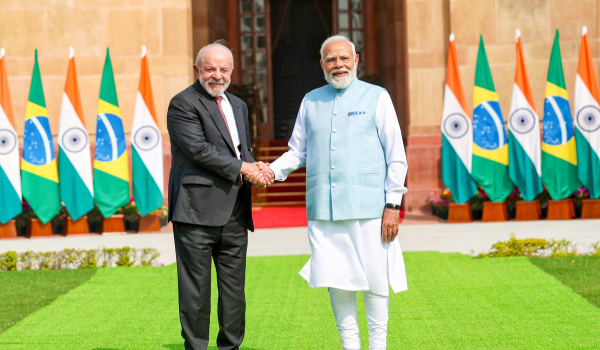
Strategic Convergence between Two Major Democracies of the Global South
The State Visit of Luiz Inácio Lula da Silva to India from 18–22 February 2026 marked a decisive moment in the evolving partnership between India and Brazil. Invited by Narendra Modi, President Lula’s visit reinforced a shared vision of cooperation rooted in democracy, development, and leadership of the Global South. As two large, diverse, and pluralistic societies, India and Brazil increasingly view each other as natural strategic partners in a rapidly changing global order.
A Relationship Anchored in Shared Values
India–Brazil relations are built on common democratic values, respect for multilateralism, and a strong commitment to inclusive growth. The Brazil–India Strategic Partnership, formally established in 2006, reflects a convergence of interests across economic, political, technological, and social domains. During the 2026 visit, both leaders reaffirmed the principles outlined in the 2025 Brasília Joint Statement, “India and Brazil: Two Great Nations with Higher Purposes”, which set a ten-year strategic roadmap across five priority pillars—defence, food security, energy transition, digital transformation, and industrial partnerships.
This continuity underscores a mature relationship that goes beyond symbolism and focuses on institutional depth and long-term collaboration.
Trade and Economic Cooperation: Momentum with Ambition
Economic ties have emerged as a central pillar of India–Brazil friendship. Bilateral trade recorded an impressive 25.5% growth in 2025 compared to the previous year, reflecting renewed business confidence and sectoral complementarities. Both leaders reiterated their commitment to achieving a bilateral trade target of USD 30 billion by 2030.
Key discussions focused on removing non-tariff barriers, addressing anti-dumping disputes, and creating a predictable regulatory environment for businesses. The entry into force of the Cooperation and Facilitation Investment Agreement and the amended Double Taxation Avoidance Protocol has further strengthened investor confidence, enabling smoother capital flows and long-term investment planning.
Importantly, India and Brazil also emphasized the strategic role of the India–MERCOSUR Preferential Trade Agreement. Recognising its untapped potential, both sides committed to expanding its scope and depth, particularly in agriculture, agro-industry, and industrial goods. This expansion reflects a broader ambition to integrate India more closely with Latin American value chains.
Digital Partnership and Emerging Technologies
A defining outcome of the visit was the signing of the Joint Declaration on Digital Partnership for the Future, positioning digital cooperation at the heart of bilateral diplomacy. Both countries—recognized globally for their Digital Public Infrastructure (DPI)—committed to collaboration in artificial intelligence, digital governance, and population-scale digital service delivery.
The leaders highlighted cooperation on AI strategies, large language models, data protection frameworks, and applications in education and public service delivery. This partnership aligns with multilateral efforts under the United Nations, UNESCO, and BRICS, reinforcing India and Brazil’s shared approach to ethical, inclusive, and development-oriented AI governance.

Health, Knowledge, and Innovation
India and Brazil also deepened cooperation in healthcare and pharmaceuticals, recognising the importance of affordable and equitable access to medicines across the Global South. Agreements between regulatory authorities—Brazil’s ANVISA and India’s CDSCO—aim to fast-track approvals and support co-development of vaccines, oncology drugs, and treatments for socially determined diseases.
A landmark development was Brazil’s access to India’s Traditional Knowledge Digital Library (TKDL), strengthening global efforts to prevent biopiracy and protect indigenous knowledge systems. This cooperation enhances patent examination quality while safeguarding traditional heritage—an area where India has emerged as a global leader.
Energy Transition and Climate Leadership
Climate cooperation featured prominently, reflecting both nations’ leadership roles in global environmental governance. India commended Brazil’s successful hosting of COP30 in Belém and welcomed Brazil’s initiatives such as the Tropical Forests Forever Facility. Both countries reaffirmed commitments to renewable energy, sustainable biofuels, green hydrogen, and critical minerals essential for clean-energy transitions.
Agreements on rare earths and critical minerals signal a strategic intent to build resilient and diversified supply chains—reducing dependency risks while supporting green industrialisation.
Defence, Security, and Multilateral Voice
Defence and security cooperation continues to expand, with emphasis on co-design, co-production, and industrial partnerships aligned with India’s Atmanirbhar Bharat vision and Brazil’s defence industrial capabilities. Cooperation also extends to cybersecurity, counter-terrorism, maritime security, and space exploration.
On the global stage, India and Brazil reaffirmed mutual support for reforming international institutions, particularly the United Nations Security Council. Their coordination within BRICS, IBSA, G20, and other multilateral forums reflects a shared commitment to amplifying the voice of the Global South.
People-to-People Ties: The Human Foundation
Beyond diplomacy and trade, the partnership is increasingly people-centric. Expanded visa validity, growing academic exchanges, cooperation in culture, yoga, cinema, tourism, and youth innovation initiatives are deepening societal bonds. These exchanges ensure that the strategic partnership is not only state-driven but socially embedded.
The 2026 State Visit reaffirmed that India–Brazil relations have entered a phase of strategic maturity. Anchored in trust, economic ambition, digital cooperation, and global responsibility, the friendship between India and Brazil stands as a model of South–South cooperation. As both nations look toward 2030 and beyond, their partnership is poised to play a critical role in shaping a more inclusive, resilient, and multipolar world order.


Leave a Reply