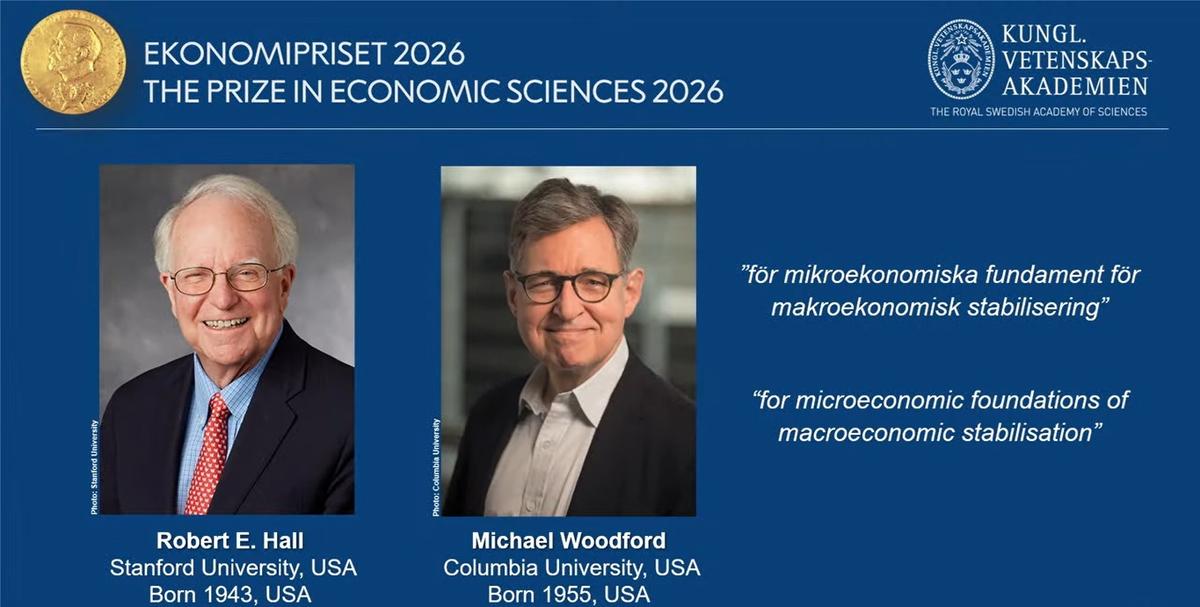
The Royal Swedish Academy of Sciences named Americans Robert Hall and Michael Woodford the winners of the 2026 economics prize “for microeconomic foundations of macroeconomic stabilisation”. The award carries 12 million Swedish crowns, about $1.2 million. The timing is pointed. Central banks are still working through the 2022 inflation surge that followed the pandemic, and they are now dealing with an energy shock triggered by the Iran war. The Academy has chosen to honour the question those institutions face every day: how do you steady an economy that keeps lurching between boom and bust?
The problem the laureates set out to solve
Mid-century “Keynesian” macroeconomics was built on broad aggregates, such as total consumption, total investment and the overall price level. Policymakers moved these dials and expected predictable results. A member of the prize committee, Timo Boppart, summed up the result with a verdict that is hard to improve on: the recipe worked well until it didn’t. The 1970s broke it. High unemployment and soaring inflation appeared together, which forced economists to revise their models.
The deeper flaw was that the aggregates hid the people behind them. Households decide whether to save or spend based on what they expect to earn. Firms decide whether to hire or invest based on what they expect to sell. If policy changes those expectations, the relationships economists had measured in the past can change as well. A model that ignores this can fail at the moment it is needed most.
The Nobel committee credits the two laureates with answering this problem. In separate bodies of work, they improved the Keynesian model by accounting for how consumers and businesses actually decide whether to invest and spend. The committee called the result a paradigm shift in the theory of stabilization policy.
Robert Hall: the household and the labour market
Hall was born in 1943 and is an emeritus professor at Stanford University and a senior fellow at the Hoover Institution. His contribution comes from two directions.
The first is consumption. A household that expects to earn a steady income over a lifetime does not rewrite its spending plans every time a paycheque changes. It reacts to news about its long-run prospects. This insight, which Hall developed in the late 1970s, changed how economists think about the effect of tax cuts, stimulus cheques and income shocks. A transfer that people see as temporary will often be saved or used to pay down debt, so it does less than a simple multiplier predicts.
The second is unemployment. Hall helped to establish the view that joblessness is more than a gap between labour supply and demand. It is a process in which workers and firms search for each other, bargain over wages, and sometimes fail to match for long stretches. In this framework the rate of hiring responds to the expected profit from a new worker. Wage rigidity can then turn a modest downturn into a deep rise in unemployment. The Korean press summary of his work emphasises his research on unemployment and wages, and on the prolonged stagnation after the financial crisis. His practical record also matters, because he has advised the US Treasury, the Justice Department and the Federal Reserve Board.
Michael Woodford: expectations as a policy instrument
Woodford was born in 1955 and is a professor of political economy at Columbia University and a leading figure in modern monetary economics. He is best known for building the New Keynesian framework into a coherent tool for central banks. That framework takes the idea of price stickiness seriously. His work, along with Hall’s, promoted the idea of “sticky” inflation, in which prices adjust to demand only with a delay. Because prices do not move instantly, demand shocks can leave real effects in the economy before inflation catches up. This is why the central bank has room to act.
His most visible legacy is forward guidance. The core idea is that the central bank affects the economy through the whole expected path of interest rates, and the single rate set today is only one point on that path. If a central bank can persuade markets that rates will stay low for a long time, it eases financial conditions today without moving the policy rate at all. This became essential after 2008. Rates had fallen to near zero or below, and standard monetary policy seemed to have run out of ammunition. Woodford himself described the later period this way: more explicit statements about the likely future path of interest rates were an important part of the policy response in the years after the crisis.
Woodford also contributed to the design of the policy rule itself. His work asked what a central bank should target and how it should respond to shocks. Within that analysis, the damage that inflation and output swings do to welfare can be measured, which gives policy a clear goal. The committee noted that this work helps in understanding how monetary and fiscal policy can tackle inflation, recessions and economic shocks by building on the decisions of households and firms.
Why the combination makes sense
Hall and Woodford approached the problem from different sides, and the pairing is natural. Hall mostly worked on the real economy, with its workers, jobs and consumption plans. Woodford mostly worked on the nominal side, with prices, interest rates and central bank communication. A complete stabilisation framework needs both. A central bank that understands price stickiness but not how unemployment behaves cannot weigh the cost of a recession against the cost of inflation. One that understands the labour market but not expectations will miss how much of its power runs through what it says.
The press coverage describes the result as ground-up models now used by central banks and finance ministries around the world. This matters in practice. When an official explains why the policy rate will stay high or fall, the reasoning usually draws on the structure these two scholars helped to build.
What the prize says about today’s policy debate
The award arrives while the framework is under open debate. The AP report notes that the new Fed chair, Kevin Warsh, has said the trend toward forward guidance went too far. Critics make a reasonable case. Detailed promises about the future can box central banks in, can lead markets to treat guidance as a commitment, and can create volatility when the data changes and the central bank has to retreat. The inflation episode that began in 2021 sharpened these doubts, because policy was judged to have been slow to respond.
The prize does not settle that argument, and it was not meant to. Recognising the foundations of a field is different from endorsing every use of it. A fair reading is that forward guidance is a tool with a time and a place. It was powerful when rates were stuck near zero and the problem was too little demand. It is less obviously suited to a period of supply shocks and high inflation, when credibility matters more than reassurance. Woodford’s own analysis points that way. His research also offered guidance on how central banks should respond to energy price shocks, which is exactly the situation many economies now face.
The wider significance
There are three lessons for policymakers, investors and researchers.
First, expectations are a real economic force. Governments and central banks shape what people believe, and those beliefs feed into spending, hiring and pricing. Policy that ignores this will keep producing surprises.
Second, models built on individual decisions give a more reliable basis for evaluating policy than simple correlations. They let analysts ask what would happen under a different regime, and not only what happened under the old one.
Third, the field is still developing. The financial crisis, the pandemic and the energy shock of recent years have each exposed gaps in the framework. The Nobel recognises a body of work that has been tested and has proved useful, and it also leaves open the work of extending it to inflation dynamics, fiscal-monetary interaction and supply-driven shocks.
The 2026 prize honours two scholars who spent decades closing the distance between how individuals behave and how whole economies move. Hall showed how households and the labour market respond to risk, shocks and search frictions. Woodford showed how interest rates, prices and the credibility of central banks shape the path of the economy. Together their work gave stabilisation policy a more disciplined base. That base is now being tested by the same kinds of pressure it was designed to address, which makes the timing of the award more than ceremonial.


Leave a Reply