
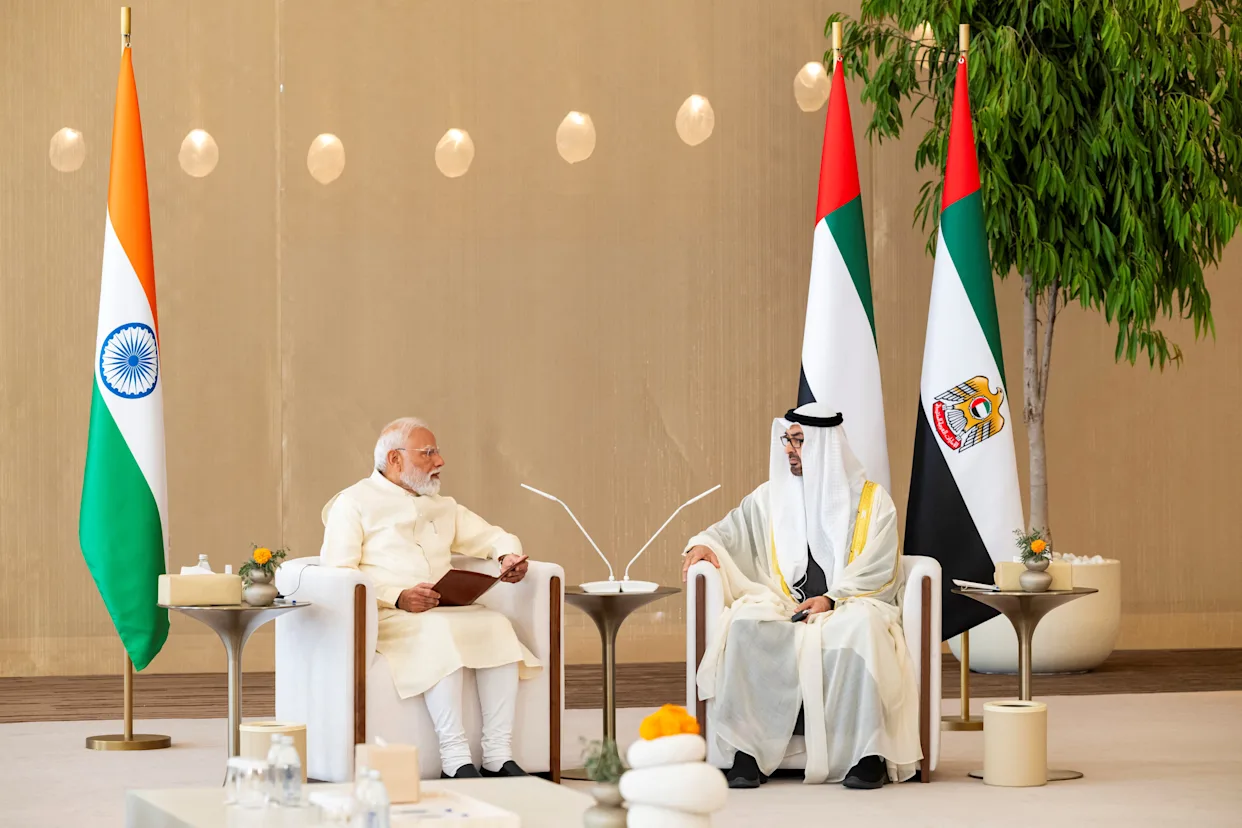
The Prime Minister Narendra Modi’s May 2026 visit to the United Arab Emirates marks a significant evolution in India’s foreign and economic policy. The visit moved beyond traditional diplomacy and highlighted the emergence of a deeper strategic partnership focused on energy security, defence cooperation, artificial intelligence, logistics, investment, and technological modernization. The agreements signed during the visit reflect India’s broader policy shift toward building resilient economic partnerships with trusted geopolitical actors in a rapidly changing global order.
The India–UAE relationship has historically been rooted in trade and people-to-people ties. However, over the last decade, the partnership has transformed into a comprehensive strategic framework driven by economic interdependence and geopolitical alignment. Bilateral trade crossed US$100 billion in FY 2025–26, while both countries have set a target of US$200 billion by 2032. UAE investments in India have also expanded significantly, particularly in infrastructure, energy, logistics, and financial services.
From a policy perspective, the most important outcome of the visit is the strengthening of India’s energy security architecture. India remains one of the world’s largest energy importers and faces vulnerabilities arising from global supply disruptions and geopolitical instability in oil-producing regions. The strategic collaboration between Indian Strategic Petroleum Reserves Limited (ISPRL) and Abu Dhabi National Oil Company (ADNOC) is therefore highly significant. The agreement enhances India’s strategic petroleum reserve capacity and improves resilience against future oil shocks.
The policy importance of this agreement lies in diversification and predictability. India has increasingly recognized that energy security is not merely an economic issue but a national security concern. Long-term partnerships with stable suppliers like the UAE reduce dependence on volatile spot markets and provide strategic leverage during periods of international uncertainty. Additionally, cooperation in LNG and LPG infrastructure aligns with India’s transition toward cleaner energy sources and supports domestic welfare schemes dependent on affordable LPG access.
Outcome 1: MoU on Strategic Collaboration between Indian Strategic Petroleum Reserves Limited (ISPRL) and Abu Dhabi National Oil Company (ADNOC)

The agreement will strengthen India’s energy security through deeper cooperation in the hydrocarbons sector. It will ensure reliable access to critical energy resources. The partnership will also enhance India’s Strategic Petroleum Reserves framework. This will improve resilience against global supply disruptions and energy market volatility.
The agreement will create new opportunities in Liquefied Natural Gas (LNG) and Liquefied Petroleum Gas (LPG) storage infrastructure. It will support India’s efforts to diversify energy sources and expand storage capacity. The partnership will also help build a secure and future-ready energy ecosystem.

Outcome 2: Strategic Collaboration Agreement between Indian Oil Limited (IOCL) Company and Abu Dhabi National Oil Company (ADNOC) on supplies of Liquified Petroleum gas (LPG)

Outcome 3: Framework for the Strategic Defence Partnership
The framework will strengthen defence industrial cooperation between both countries. It will encourage joint partnerships, co-development, and greater industry engagement. The agreement would also promote innovation and technology sharing in strategic sectors. This will support cooperation in advanced defence manufacturing and capabilities. At the broader level, the partnership is expected to enhance national and regional security cooperation.
Outcome 4: MoU between Cochin Shipyard Limited (CSL) and Drydocks World (DDW) on setting up Ship Repair Cluster at Vadinar, Gujarat

The initiative will boost shipping, port, and coastal infrastructure development. It will strengthen India’s position as a growing maritime and logistics hub. The collaboration will also improve the maritime logistics ecosystem. It will enhance ship repair and allied industrial capabilities. This will support efficient trade and connectivity. The partnership will also advance the Make in India initiative. It will promote domestic manufacturing, infrastructure development, and indigenous maritime capabilities.
Outcome 5: MoU between Cochin Shipyard Limited (CSL), Drydocks World (DDW) and Centre of Excellence in Maritime & Shipbuilding (CEMS) on Skill Development in Ship Repair

Outcome 6: Term Sheet for setting up 8 Exaflop Super Computing Cluster in partnership between CDAC, India and G-42, UAE

The partnership will accelerate India’s sovereign AI and high-performance computing capabilities. It will strengthen the country’s supercomputing infrastructure. The collaboration will also boost the IndiaAI Mission. It will support digital innovation, AI research, and next-generation technological development.
The partnership will accelerate India’s sovereign AI and high-performance computing capabilities. It will strengthen the country’s supercomputing infrastructure. The collaboration will also boost the IndiaAI Mission. It will support digital innovation, AI research, and next-generation technological development.
Outcome 7: Investment from UAE to India
The investment commitments will strengthen economic and financial cooperation between both countries. They will boost investments in India’s infrastructure and banking sectors. The commitments will also enhance long-term capital flows and investor confidence. They will support India’s economic development and infrastructure expansion goals.
Overall, the outcomes of the Prime Minister’s visit reflect the transformation of bilateral ties into a future-oriented strategic partnership. The cooperation is anchored in trust, innovation, and shared prosperity. The agreements deepen collaboration across traditional sectors such as energy, trade, and defence. They also open new opportunities in frontier technologies, logistics, digital infrastructure, and advanced manufacturing.
Another major policy breakthrough is the agreement on an 8 Exaflop supercomputing cluster partnership between India’s Centre for Development of Advanced Computing (C-DAC) and UAE-based G42. This reflects India’s growing ambition to become a global leader in artificial intelligence and high-performance computing.
The policy implications of this collaboration are substantial. AI infrastructure is becoming the foundation of future economic competitiveness, defence preparedness, digital governance, and industrial innovation. By partnering with the UAE, India is attempting to accelerate indigenous AI capabilities while reducing dependence on Western technology ecosystems. This aligns closely with the IndiaAI Mission and the government’s broader digital sovereignty agenda.
The supercomputing initiative also demonstrates a shift in India’s strategic partnerships from traditional resource-driven relations toward technology-driven cooperation. Unlike earlier Gulf partnerships primarily centered around oil imports and remittances, the new framework positions the UAE as a technological and investment partner in India’s digital transformation.
Defence cooperation emerging from the visit also deserves close policy attention. The framework for strategic defence partnership aims to encourage co-development, industrial collaboration, and technology sharing. This is consistent with India’s long-term objective of reducing defence import dependence through the “Make in India” and “Atmanirbhar Bharat” initiatives.
For India, collaboration with the UAE offers several advantages. First, it enhances regional maritime security in the Indian Ocean and Gulf region, which are critical for global energy trade routes. Second, it opens opportunities for joint manufacturing and defence innovation. Third, it contributes to balancing emerging geopolitical uncertainties in West Asia by building stronger strategic alignments with moderate regional powers.
The maritime and logistics agreements signed during the visit are equally significant. The MoU between Cochin Shipyard Limited and Drydocks World for developing a ship repair cluster at Vadinar, Gujarat, strengthens India’s ambitions of becoming a global maritime hub.
India’s logistics and shipping sector has long suffered from infrastructure bottlenecks and high transaction costs. Strengthening ship repair, coastal infrastructure, and maritime connectivity can improve trade efficiency and support India’s integration into global supply chains. This also complements initiatives such as PM Gati Shakti and Sagarmala, which aim to modernize transport and logistics infrastructure across the country.
The emphasis on skill development in shipbuilding and maritime services further reflects an important domestic policy dimension. India’s demographic advantage can only translate into economic gains if supported by specialized technical training and industry-ready capabilities. The agreement involving the Centre of Excellence in Maritime & Shipbuilding (CEMS) supports this objective by linking strategic cooperation with workforce development.
Economically, UAE investment commitments toward Indian infrastructure and banking sectors reinforce India’s strategy of attracting long-term foreign capital for growth. Sovereign wealth funds from the Gulf are increasingly becoming important financiers of India’s infrastructure expansion. Such investments are particularly valuable because they are often patient capital with long investment horizons.
From a geopolitical standpoint, the India–UAE partnership also reflects the rise of geoeconomics in foreign policy. Economic cooperation, supply chain resilience, technology partnerships, and strategic investments are now central instruments of diplomacy. India’s engagement with the UAE demonstrates how middle powers are building flexible partnerships that are not solely dependent on traditional Western alliances.
The Local Currency Settlement system between India and the UAE is another notable development. By enabling trade in INR and AED, both countries are attempting to reduce dollar dependence and lower transaction costs. While still limited in scale, such mechanisms could contribute to gradual financial diversification in global trade systems.
Overall, Prime Minister Modi’s 2026 UAE visit signals a mature and future-oriented bilateral partnership. The agreements signed are not isolated diplomatic gestures but part of a broader strategic framework linking energy security, digital sovereignty, industrial policy, logistics modernization, defence manufacturing, and economic resilience. As global power structures become increasingly multipolar, partnerships like India–UAE will play a critical role in shaping India’s long-term economic and geopolitical trajectory.
Leave a Reply