
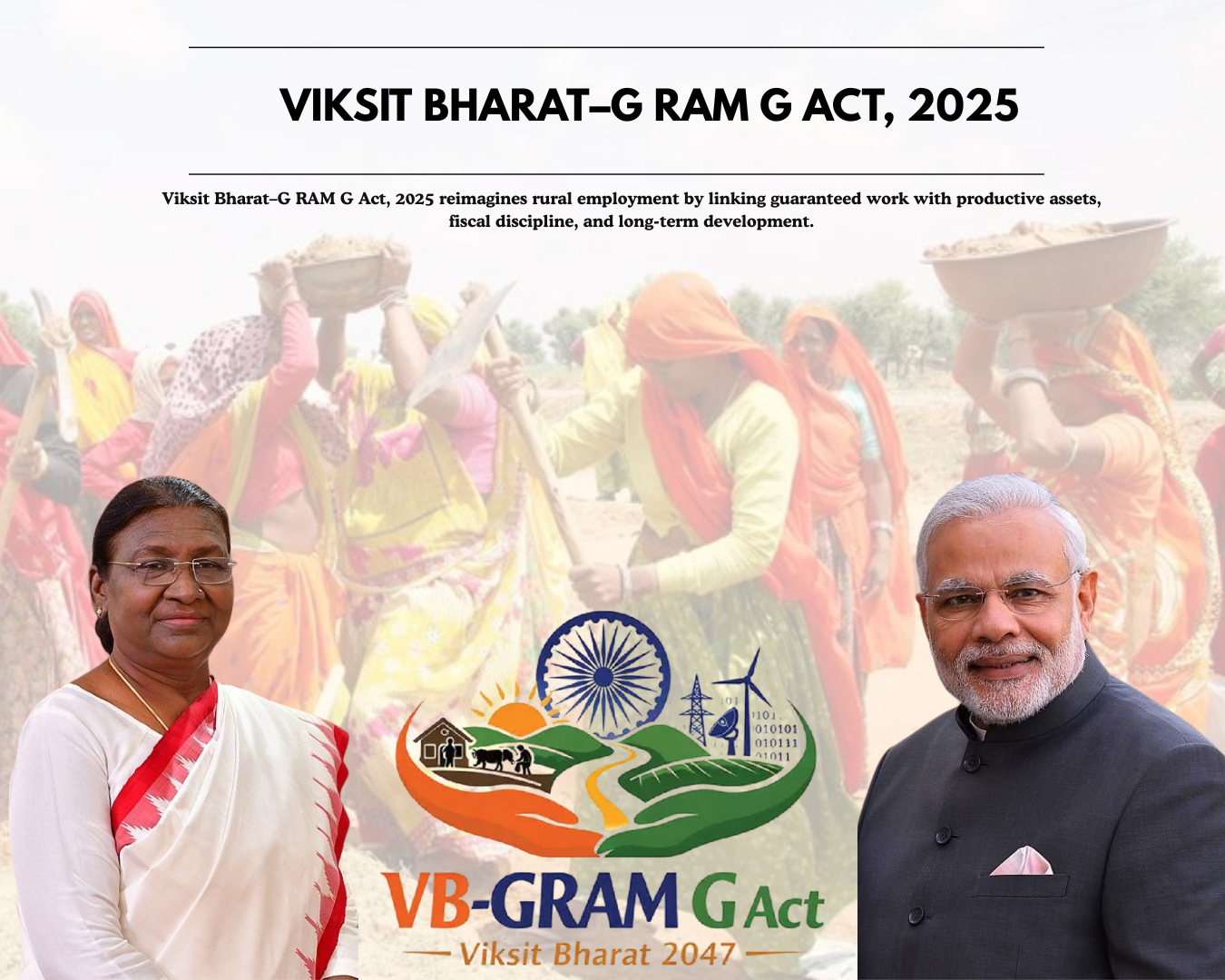
India’s rural employment policy has entered a new phase with the enactment of the Viksit Bharat–Guarantee for Rozgar and Ajeevika Mission (Gramin) Act, 2025. The Act replaces the two-decade-old MGNREGA framework with a modern statutory architecture aligned with the long-term national vision of Viksit Bharat 2047. Rather than merely expanding welfare, the new law seeks to reposition rural employment as a developmental and productivity-enhancing instrument.
Why a New Law Was Needed
MGNREGA, enacted in 2005, played a historic role in stabilising rural incomes, reducing distress migration, and providing a legal right to work. Over time, the programme achieved major gains in digitisation, transparency, women’s participation, and direct benefit transfers. However, persistent structural issues limited its effectiveness. Asset creation remained fragmented, funding was unpredictable due to a demand-based structure, and only a small proportion of households consistently completed the full 100 days of employment. Leakages, weak accountability, and limited alignment with agriculture cycles and long-term infrastructure planning continued despite technological improvements.
Meanwhile, rural India itself has changed. Poverty levels have declined sharply, livelihoods have diversified beyond agriculture, and digital connectivity has expanded widely. In this new context, a purely relief-oriented, demand-driven employment programme was no longer sufficient. The Viksit Bharat–G RAM G Act responds through a legislative reset, not incremental reform.
Core Features of the New Framework

The Act enhances the employment guarantee to 125 days of wage employment per rural household per year, strengthening income security while recognising contemporary rural realities. Wages are to be paid weekly or, at the latest, within a fortnight. Importantly, the law mandates an unemployment allowance if work is not provided within 15 days, with liability placed on State governments—introducing sharper accountability.
A key innovation is the agriculture-sensitive design. States are empowered to notify a pause of up to 60 days during peak sowing and harvesting seasons, ensuring that public works do not distort farm labour markets or cause wage inflation. This balances the interests of labourers and farmers while improving agricultural productivity.
From Wage Employment to Asset-Led Development
Unlike MGNREGA’s broad and scattered list of permissible works, the new Act anchors employment creation to four clearly defined priority verticals:
-
Water security and groundwater recharge
-
Core rural infrastructure such as roads and sanitation
-
Livelihood-related infrastructure including storage, markets, and production assets
-
Climate resilience works addressing floods, droughts, and extreme weather
All assets created are integrated into the Viksit Bharat National Rural Infrastructure Stack, ensuring convergence with national planning platforms such as PM Gati Shakti. This marks a shift from short-term works toward durable, productivity-enhancing rural assets.
A Major Shift in Financial Architecture
One of the most consequential policy changes lies in funding design. MGNREGA operated as a central sector scheme with demand-based funding, leading to unpredictable allocations and weak fiscal discipline. The Viksit Bharat–G RAM G Act moves to a centrally sponsored scheme with normative allocations.
Under the new framework:
-
The standard cost-sharing ratio is 60:40 between Centre and States
-
90:10 support is provided for North-Eastern and Himalayan states
-
Union Territories without legislatures receive 100% central funding
Normative funding improves budget predictability, aligns rural employment with standard public finance practices, and strengthens cooperative federalism without diluting the legal employment guarantee
Governance, Technology, and Accountability
The Act embeds technology deeply into governance. Biometric attendance, AI-based fraud detection, GPS-enabled monitoring, real-time dashboards, and mandatory social audits at least once every six months are institutionalised. Weekly public disclosures enhance transparency.
Crucially, the Central Government is empowered to investigate complaints, suspend fund releases in cases of serious irregularities, and direct corrective action. This represents a significant strengthening of enforcement mechanisms compared to the earlier regime.
Decentralisation with National Integration
Planning and execution are decentralised through Viksit Gram Panchayat Plans, with Gram Panchayats implementing at least half of the works by cost. At the same time, national and state-level councils and steering committees ensure policy coherence, convergence, and performance monitoring. This structure balances local knowledge with national development priorities.
A Structural Upgrade, Not Retrenchment
The Viksit Bharat–G RAM G Act, 2025 should be understood not as a rollback of rural employment guarantees, but as their evolution. By linking employment to infrastructure, climate resilience, and fiscal discipline, the Act transforms rural wage employment from a safety net into a strategic development tool.
If implemented effectively, it has the potential to raise rural incomes, strengthen agricultural productivity, reduce distress migration, and align grassroots employment policy with India’s long-term growth ambitions under Viksit Bharat 2047.
Leave a Reply