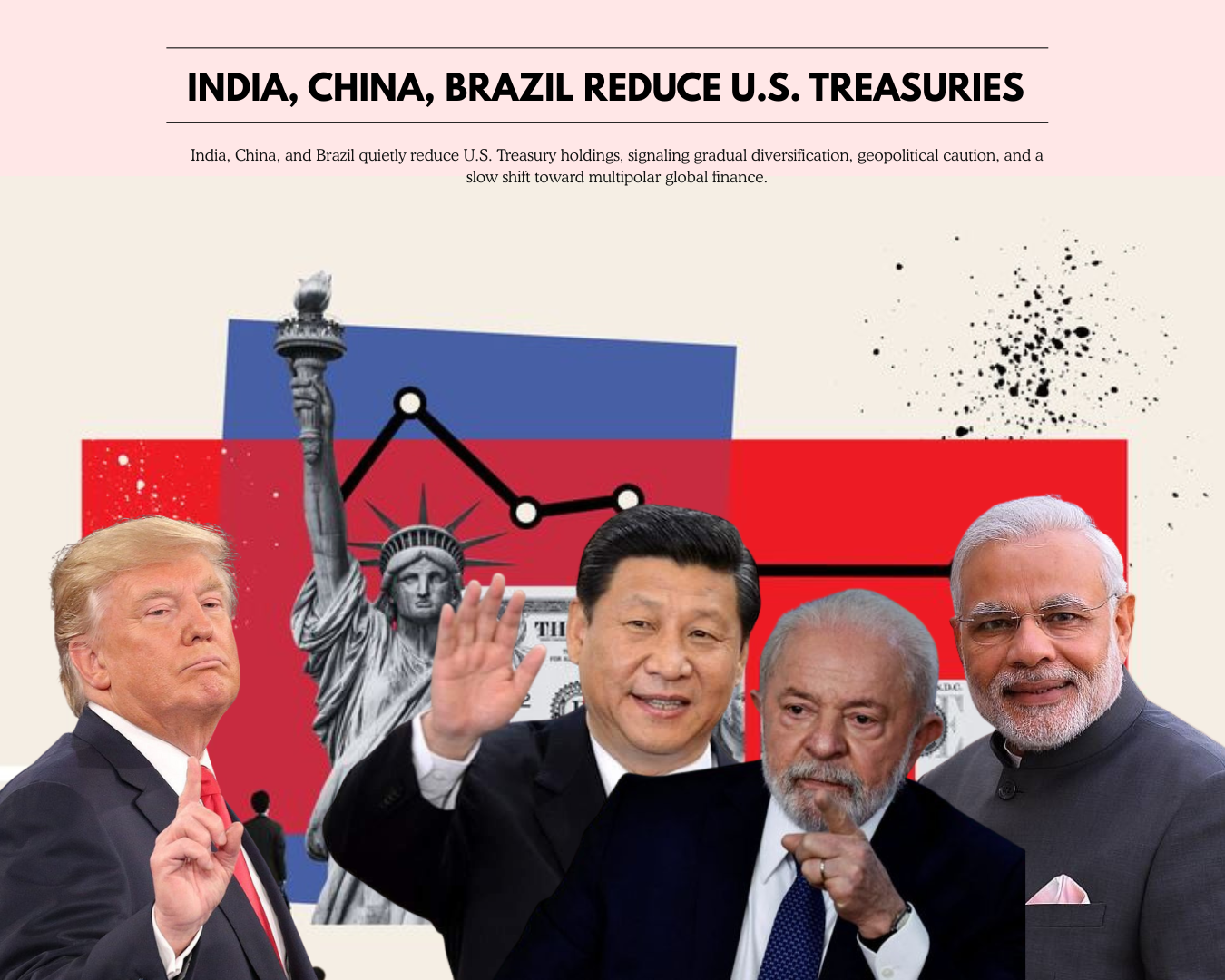
The U.S. Treasury market remains the backbone of the global financial system, absorbing surplus savings and anchoring the dominance of the U.S. dollar. Yet recent data suggests a subtle but important shift underway. Large emerging economies—particularly India, China, and Brazil—are steadily reducing their holdings of U.S. Treasuries. This is not a dramatic exit or a coordinated political move, but a gradual rebalancing driven by structural, macroeconomic, and geopolitical considerations.
Data Trends: Evidence of a Gradual Decline
U.S. Department of the Treasury (Treasury International Capital (TIC)) data from late 2024 to October 2025 shows a clear downward trend in U.S. Treasury holdings among these three economies.
China’s holdings declined from $760.1 billion (October 2024) to $688.7 billion (October 2025). India reduced its exposure more sharply in relative terms, from $241.4 billion to $190.7 billion over the same period. Brazil’s holdings fell from $228.8 billion to $167.7 billion, with the most pronounced drawdown occurring in mid-to-late 2025.

| Country | 2025-10 | 2025-09 | 2025-08 | 2025-07 | 2025-06 | 2025-05 | 2025-04 | 2025-03 | 2025-02 | 2025-01 | 2024-12 | 2024-11 | 2024-10 |
| China, Mainland | 688.7 | 700.5 | 701 | 696.9 | 732.7 | 732.7 | 743.6 | 765.4 | 784.3 | 760.8 | 759 | 768.6 | 760.1 |
| India | 190.7 | 202.7 | 219.4 | 219.7 | 227.4 | 235.3 | 232.5 | 239.9 | 228 | 225.7 | 219.1 | 234 | 241.4 |
| Brazil | 167.7 | 172.7 | 184.5 | 201.7 | 215.3 | 212 | 212 | 208.4 | 207.3 | 199.4 | 201.6 | 229 | 228.8 |
| Japan | 1200 | 1189.3 | 1180.4 | 1151.8 | 1148 | 1135 | 1134.5 | 1130.8 | 1125.9 | 1079.3 | 1061.5 | 1087.1 | 1101.5 |
Source: U.S. Department of the Treasury
https://ticdata.treasury.gov/resource-center/data-chart-center/tic/Documents/slt_table5.html
Japan’s Treasury holdings increased from $1.10 trillion to $1.20 trillion, underscoring that the pullback is not global but concentrated among select emerging economies. This divergence is critical: it suggests the trend is driven less by concerns about U.S. creditworthiness and more by country-specific reserve management strategies.
China: Strategic Diversification, Not Disengagement
China’s declining Treasury holdings must be viewed in a long-term context. After years of accumulation driven by trade surpluses and exchange-rate management, China has entered a phase of strategic diversification. Rising geopolitical tensions, exposure to financial sanctions, and the cost of holding low-yield foreign debt have all contributed to this recalibration.
Rather than liquidating Treasuries aggressively, China has reduced holdings gradually while increasing allocations to gold and promoting the use of the renminbi in bilateral trade. This approach minimizes market disruption while reducing vulnerability to U.S. monetary tightening and geopolitical leverage. Importantly, China remains a major Treasury holder, reinforcing that this is a rebalancing exercise rather than a rejection of the dollar system.
India: Reserve Resilience and Macroeconomic Autonomy
India’s approach reflects a different set of priorities. The Reserve Bank of India has historically emphasized liquidity, safety, and capital preservation. However, India’s steady reduction in Treasury holdings signals a growing focus on macroeconomic autonomy.
High U.S. interest rates transmit tightening financial conditions globally, putting pressure on emerging market currencies and capital flows. By diversifying reserves toward gold and non-dollar assets, India aims to reduce imported volatility while maintaining sufficient dollar liquidity to manage external shocks. India’s exploration of local-currency trade mechanisms with select partners further supports this objective, though these arrangements remain limited in scale.


USD to INR trades at 89.5 on December 24, 2025, down from the historic 91+ peak hit mid-December amid FII outflows, US trade tensions under President Trump, and dollar surge. INR weakens past 91, requiring more rupees per dollar, signaling depreciation pressures from imports and inflation risks, not strength. RBI interventions aided recovery to current 89.47-89.66 band. Recent breach of 91.38 marked record low, easing via reserves and fundamentals. Outlook mixed: forecasts eye 87 strengthening by 2026 on growth, or 93-95 risks from global shocks. Monitor Fed rates, oil, and policy shifts for volatility.
Brazil: Managing Cyclicality and External Vulnerability
Brazil’s Treasury drawdown reflects its sensitivity to global financial cycles. As a commodity-exporting economy, Brazil experiences significant swings in trade balances and capital flows. Heavy reliance on dollar-denominated assets can amplify these cycles, especially during periods of U.S. monetary tightening.
Reducing Treasury exposure allows Brazil to hedge against dollar volatility and reallocate reserves in ways that better align with domestic macroeconomic needs. While Brazil’s strategy lacks the scale and institutional ambition of China’s, the direction is consistent with a broader emerging-market preference for diversification.
Implications for the U.S. Treasury Market
Despite these shifts, the U.S. Treasury market remains resilient. Domestic investors, pension funds, insurers, and other foreign holders continue to absorb issuance. The gradual nature of the drawdown ensures that yields and liquidity remain stable in the near term.
However, the long-term implications are more consequential. If emerging economies increasingly diversify at the margin, the automatic recycling of global savings into U.S. debt may weaken. Over time, this could marginally raise U.S. borrowing costs and reduce the structural advantages associated with reserve currency status.
Toward a Multipolar Reserve System
The evidence points toward a slow transition to a more multipolar reserve architecture. The dollar is not being displaced, but its dominance is being diluted incrementally. Reserve portfolios are becoming more diversified, trade settlement more fragmented, and financial power more distributed. Crucially, this transition is pragmatic rather than ideological. No major economy benefits from destabilizing the existing system. India, China, and Brazil are adapting to a world of higher geopolitical risk, tighter global liquidity, and greater uncertainty.
In sum, the quiet exit from U.S. Treasuries is best understood as a risk-management strategy, not a revolt. The dollar-centric system remains intact, but its margins are shifting. How far and how fast this evolution proceeds will shape the future contours of global finance.




Leave a Reply