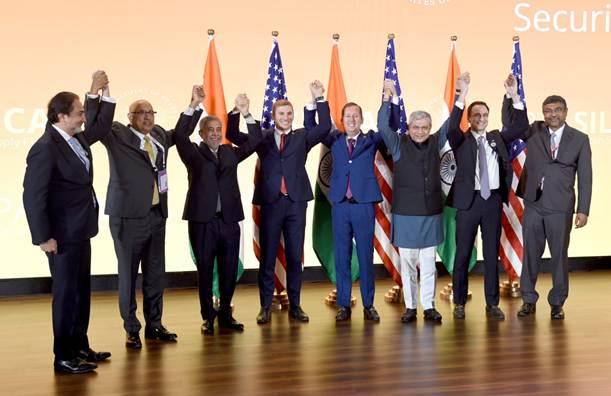
The India’s formal entry into Pax Silica marks a decisive evolution in the technology partnership between India and the United States. On 20 February 2026, India formally joined the Pax Silica coalition, strengthening strategic technology ties with the United States at the India AI Impact Summit in New Delhi, marking a pivotal shift in global technology collaboration. This move is more than a diplomatic gesture — it reflects deeper economic security concerns, geopolitical strategy, and India’s aspirations in advanced technology sectors.
At its core, Pax Silica is a US-led strategic initiative aiming to secure the entire “silicon stack” — from critical minerals and semiconductor fabrication to AI systems and digital infrastructure — among trusted, like-minded democratic nations. By embedding India into this architecture, the coalition seeks to reduce overconcentration in critical tech supply chains, prevent economic coercion, and ensure that emerging technology ecosystems are governed openly, transparently, and resiliently.
The global technology landscape is rapidly evolving, with semiconductors and AI no longer just industrial inputs but strategic assets shaping economic and defense capabilities. During the pandemic, the world witnessed how fragile and concentrated semiconductor supply chains were. Heavy dependence on a few regions for chips, rare earth elements, and other critical inputs translated into global shortages that threatened industries ranging from automotive to defense.
Pax Silica emerged in late 2025 as a response to these vulnerabilities, bringing together countries like Japan, South Korea, Singapore, the United Kingdom, and others to foster secure, resilient technology ecosystems. India’s formal inclusion signifies a broader consensus among major democracies to align on technology supply chains and counter emerging threats from coercive dependencies.
Economic and Strategic Implications for India
For India, this partnership is strategically significant on multiple fronts:
1. Industrial Upgradation and Technology Leadership
Indian Minister Ashwini Vaishnaw highlighted that India’s engineers are now designing advanced chips, including two-nanometer technology, and that the semiconductor sector could require nearly a million new skilled professionals. Aligning with Pax Silica not only validates India’s domestic efforts but opens up broader avenues for collaboration with global leaders in semiconductors and AI.
2. Supply Chain Resilience
Historically, India has been dependent on imports for critical technology inputs, especially from East Asia. Pax Silica provides a framework for diversifying supply sources, securing critical minerals, and integrating India into resilient production networks. This diversification reduces vulnerability and strengthens India’s negotiating position in global markets.
3. Geopolitical Signaling
India’s entry into Pax Silica sends a clear geopolitical message. It aligns India more closely with Western democratic partners at a time when global competition — particularly with China — is intensifying in tech arenas like AI, semiconductors, and advanced manufacturing. Building alliances around shared values of free, open, and democratic technology governance strengthens India’s global standing and serves as a hedge against coercive economic tactics by other powers.
4. Investment and Innovation Ecosystem
Integration into Pax Silica may encourage greater foreign investment, joint research initiatives, and collaborative innovation in areas like AI infrastructure, quantum computing, and semiconductor fabrication. For India’s burgeoning tech ecosystem, this means access to capital, expertise, and global markets — a combination essential for long-term technological competitiveness.
Challenges and Considerations
While the strategic benefits are clear, the partnership also brings practical challenges:
- Implementation Bottlenecks: Translating high-level commitments into actionable outcomes requires policy coherence, infrastructure readiness, and industry participation. India must fast-track regulatory frameworks, invest in manufacturing capacity, and develop talent pipelines to fully leverage Pax Silica benefits.
- Balancing Global Relations: Aligning closely with a US-led tech bloc may affect India’s diplomatic positioning with other global powers. India must balance its strategic autonomy while engaging constructively across multiple technology ecosystems.
- Competition and Standards: As India integrates with international supply chains, it must also meet global quality standards, data governance norms, and intellectual property frameworks to attract serious investment and collaborations.
Looking Ahead: A Strategic Leap
Joining Pax Silica is not merely symbolic; it represents a concerted push by India to shape the future of technology supply chains and assert itself in the global digital economy. This partnership complements India’s domestic initiatives, such as the India Semiconductor Mission and the India AI Mission, by embedding them within an international framework that prioritizes resilience, collaboration, and democratic governance of technology.
In a landscape where tech innovation defines economic power, India’s inclusion in Pax Silica marks a strategic inflection point — one that could help position the country as a key node in secure, future-ready global technology infrastructure.




Leave a Reply