
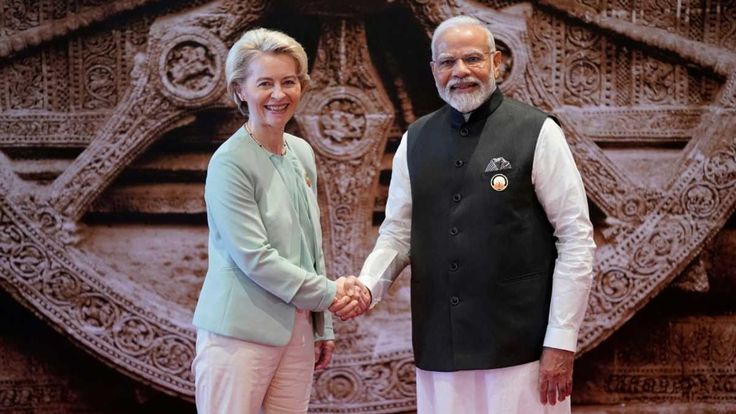
India and the European Union are on the brink of finalizing one of the most ambitious trade agreements of the 21st century. Widely described as the “Mother of All Deals”, the proposed India–EU Free Trade Agreement (FTA) is expected to redefine economic relations between two of the world’s largest democratic blocs. With negotiations nearing completion and a possible announcement during the India–EU Summit in New Delhi around 27 January 2026, the agreement carries deep economic, strategic, and geopolitical significance.
Covering a combined market of nearly 2 billion people and close to one-quarter of global GDP, this FTA would become India’s largest and most comprehensive trade pact to date. It also marks a decisive shift in India’s trade diplomacy, as global supply chains realign amid geopolitical uncertainty, rising protectionism, and renewed tariff wars.
The Trump Factor: Accelerating the India–EU Convergence
Recent trade actions by Donald Trump have significantly altered the global trade calculus. Since returning to office, Trump has revived aggressive protectionism, imposing steep tariffs on multiple partners and signalling further duties on both Indian and European exports. These moves have strained transatlantic ties and injected uncertainty into global supply chains. For India, higher US tariffs underscore the risks of over-dependence on a single market, while for the EU, Trump’s unpredictability reinforces the urgency of diversifying trade partnerships. Against this backdrop, the India–EU FTA gains strategic momentum as a stabilising anchor—offering both sides a rules-based alternative amid renewed American trade unilateralism.
A Long and Uneven Negotiation Journey
Talks for an India–EU Broad-based Trade and Investment Agreement first began in 2007, driven by optimism over deepening economic integration. However, negotiations stalled by 2013, primarily due to disagreements over tariff reductions, market access in sensitive sectors, intellectual property rights, and regulatory standards.
After nearly a decade of dormancy, discussions were re-launched in June 2022, alongside parallel tracks on an Investment Protection Agreement and Geographical Indications. The revival reflected post-pandemic realities: supply-chain disruptions, growing India–China tensions, and Europe’s search for trusted partners outside China.
Since then, negotiations accelerated rapidly. By late 2025, around 20 of the 24 chapters had reportedly reached near closure, including customs cooperation, digital trade, and trade facilitation. Multiple “stock-take” meetings in New Delhi and Brussels helped narrow remaining gaps, setting the stage for a political push at the highest level.
The Current Moment: January 2026
As of January 2026, both sides acknowledge that the deal is very close but not yet fully sealed. Speaking at the World Economic Forum in Davos, Ursula von der Leyen, President of the European Commission, stated that while “work remains,” the agreement would be historic in scale and ambition. On the Indian side, Commerce and Industry Minister Piyush Goyal has repeatedly emphasized India’s readiness to conclude a “fair, balanced, and future-oriented” deal.
A formal announcement or political conclusion is widely expected around 27 January 2026, coinciding with India’s Republic Day celebrations and the India–EU Summit in New Delhi. Even if announced, legal scrubbing, ratification by EU member states, and phased implementation will follow over the next few years.
The Existing Trade Relationship
The economic foundation for the FTA is already substantial. In 2024–25, bilateral goods trade touched approximately $136.5 billion, making the EU India’s largest trading partner in goods. India exported around $75.8 billion, led by textiles, pharmaceuticals, petroleum products, gems and jewelry, while imports from the EU stood near $60.7 billion, dominated by machinery, chemicals, and transport equipment.
Services trade adds another $50+ billion, with India enjoying strong comparative advantage in IT, business process management, and professional services. Notably, bilateral trade has grown over 35% since 2020–21, outpacing India’s trade growth with several other major partners.
Yet, despite these numbers, trade potential remains underutilized due to tariffs, non-tariff barriers, regulatory frictions, and diverging standards.
Key Sticking Points in the Negotiations
Despite the optimistic tone, several sensitive issues remain:
1. Agriculture and Dairy
India has drawn a firm red line around agriculture and dairy, seeking to protect small farmers from competition with heavily subsidized European producers. These sectors are likely to remain excluded or minimally covered, similar to India’s recent FTAs with the UK and EFTA countries.
2. Carbon Border Adjustment Mechanism (CBAM)
The EU’s CBAM, effective from 2026, poses a major challenge for Indian exports of steel, aluminum, cement, and chemicals. India has pushed for exemptions, transition periods, or mutual recognition of climate efforts, arguing that CBAM functions as a de facto carbon tariff.
3. Tariff Cuts on Sensitive EU Exports
The EU is pressing India to reduce high tariffs on automobiles, wines, spirits, and certain dairy-linked products. India remains cautious, seeking long transition periods and safeguards.
4. Mobility of Skilled Professionals
India wants easier movement for skilled workers, especially in IT, engineering, and professional services. Visa regimes, recognition of qualifications, and social security coordination remain politically sensitive in Europe.
Expected Economic Benefits
| Sector | India Gains | EU Gains |
|---|---|---|
| Textiles/Apparel | Tariff relief boosts exports to $125B EU market | – |
| Pharmaceuticals | Streamlined approvals for generics | Specialty drugs access |
| Autos/Electronics | Supply chain integration | Higher exports to India |
| Services (IT/Telecom) | Easier professional mobility | Financial/legal openings |
| Chemicals/Steel | Regulatory alignment, CBAM carve-outs sought | Diamonds, machinery sales |
If concluded and effectively implemented, the India–EU FTA could be transformative.
- Merchandise trade could potentially double to $250 billion by 2030–31.
- Services trade may rise toward $100 billion, driven by IT, telecom, finance, and engineering services.
- Tariff eliminations ranging from 2–12% would significantly enhance Indian competitiveness in labor-intensive sectors.
Sectoral Gains for India
- Textiles & apparel: Improved access to a €125-billion EU market, narrowing the gap with China, Vietnam, and Bangladesh.
- Pharmaceuticals: Faster regulatory approvals and wider access for generics.
- Gems, leather, and marine products: Reduced duties and streamlined standards.
- IT & professional services: Greater mobility and market certainty.
Benefits for the EU
- Increased exports of automobiles, aircraft components, machinery, chemicals, wines, and spirits.
- Better access to India’s fast-growing consumer market and manufacturing ecosystem.
- Stronger investment protection and supply-chain diversification.
Market and Investment Impact
Global investment banks and market analysts have already begun pricing in the potential impact. Sectors such as textiles, autos, electronics, and pharmaceuticals are viewed as key winners. Equity markets may respond positively, as the FTA diversifies India’s trade exposure away from excessive dependence on the US and China.
Estimates suggest short-term real income gains of €3–4.4 billion for each side, with larger dynamic benefits over time through productivity gains, economies of scale, and technology transfer.
Strategic and Geopolitical Significance
Beyond economics, the FTA is a strategic statement. It comes amid renewed tariff uncertainty under Donald Trump, escalating US–China rivalry, and Europe’s desire to “de-risk” rather than decouple from Asia.
For India, the deal strengthens its role as a trusted partner in global value chains and complements initiatives like the India–EU Trade and Technology Council. For Europe, it offers a first-mover advantage in one of the world’s fastest-growing large economies.
This would also be India’s 19th major FTA, underscoring a more outward-looking trade strategy after years of relative caution.
Challenges After Signing
Even after political conclusion, challenges remain:
- Compliance costs linked to CBAM and EU sustainability standards.
- Persistent non-tariff barriers, especially sanitary and phytosanitary rules.
- Lengthy ratification processes within the EU.
- The need to balance domestic political economy concerns with openness.
The India–EU Free Trade Agreement stands at a historic crossroads. If finalized, it will not merely be another trade pact, but a cornerstone of 21st-century economic diplomacy—linking two democratic powers in an era of fragmentation and uncertainty. While risks and implementation challenges persist, the potential rewards in trade, investment, jobs, and strategic autonomy make the “Mother of All Deals” a defining moment in India–EU relations.
Leave a Reply