
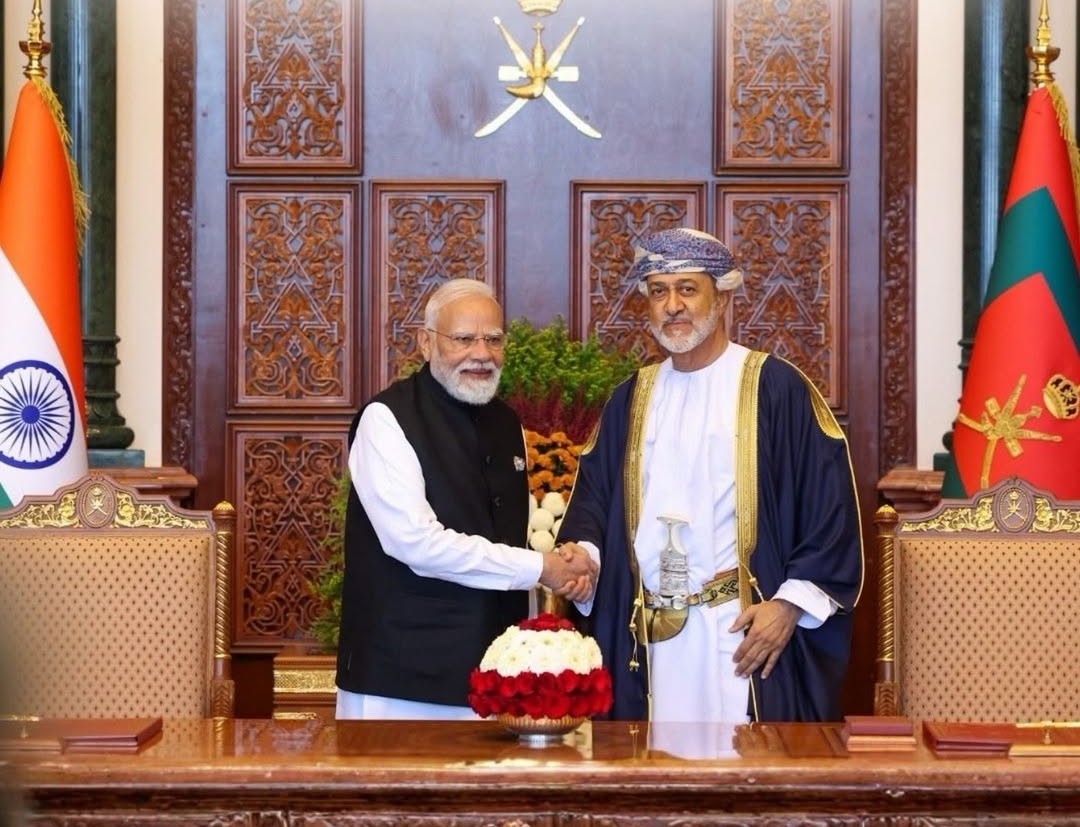
India and Oman have elevated their long-standing economic and cultural ties to a new strategic level with the signing of the Comprehensive Economic Partnership Agreement (CEPA) on December 18, 2025. The agreement, inked in the presence of Prime Minister Shri Narendra Modi and His Majesty Sultan Haitham bin Tarik, was signed by Commerce and Industry Minister Shri Piyush Goyal and Oman’s Minister of Commerce, Industry & Investment Promotion H.E. Qais bin Mohammed Al Yousef. This landmark pact marks India’s second free trade agreement (FTA) in just six months, following the one concluded with the United Kingdom, reinforcing India’s proactive global trade diplomacy.
Expanding India’s Strategic Presence in the Gulf
The CEPA with Oman comes at a crucial juncture as India deepens its engagement across the Gulf Cooperation Council (GCC) region. Oman serves as a vital gateway for India to the Middle East and Africa, given its central geographical location and historical trade linkages with the Indian subcontinent.
Today, nearly seven lakh Indian nationals reside in Oman, forming one of the largest expatriate communities and contributing significantly to the Omani economy. Over 6,000 Indian businesses operate across diverse sectors, generating annual remittances of about USD 2 billion. Bilateral trade between the two nations currently stands at over USD 10 billion, a figure expected to grow exponentially under the CEPA framework.
By providing Indian companies secure market access and facilitating mobility for professionals, the agreement is poised to strengthen India’s footprint in one of the world’s most dynamic regions.
Unprecedented Market Access and Tariff Concessions
The core strength of the India–Oman CEPA lies in its near-universal tariff elimination. Oman has agreed to provide zero-duty access on 98.08% of its tariff lines, effectively covering 99.38% of India’s exports by value. Major labour-intensive sectors such as textiles, leather, footwear, gems and jewellery, sports goods, plastics, furniture, agricultural products, engineering goods, automobiles, pharmaceuticals, and medical devices stand to benefit substantially.
Out of Oman’s total tariff lines, 97.96% will see immediate elimination, offering a timely boost to Indian exporters. This access will generate new employment opportunities, particularly empowering MSMEs, artisans, and women-led enterprises by expanding their global reach.
From India’s side, tariff liberalization will cover 77.79% of its total tariff lines (12,556), which corresponds to 94.81% of India’s imports from Oman by value. However, India has carefully safeguarded its sensitive sectors such as agriculture (dairy, tea, and coffee), rubber, tobacco, precious metals, and base metal scrap, keeping them under exclusion or tariff-rate quota (TRQ) categories to protect domestic producers.
Services Sector: The Next Frontier
Beyond goods, the CEPA’s most visionary component is its services chapter, which reflects Oman’s ambitious and forward-looking approach. It offers commitments in 127 sub-sectors, including computer-related services, business and professional services, audiovisual, R&D, education, and health services.
Given Oman’s global services imports of USD 12.5 billion, India currently holds only a 5.3% share, indicating vast untapped potential. The CEPA aims to close this gap, empowering Indian IT, consulting, and professional service providers to expand in Oman’s rapidly modernizing economy.
An especially transformative feature is enhanced mobility for Indian professionals. Under Mode 4, Oman has agreed to liberalize temporary entry and stay provisions for intra-corporate transferees, contractual service suppliers, business visitors, and independent professionals. The quota for intra-corporate transferees rises from 20% to 50%, while the allowed stay for service providers extends from 90 days to two years, renewable for another two years. This new flexibility will create a smoother pathway for accountants, architects, doctors, and allied professionals from India to operate in Oman.
Investment and Regulatory Cooperation
The CEPA also opens major doors for Indian investment in Oman. Indian firms can now establish 100% foreign-owned enterprises across key service sectors (Mode 3), enabling deeper integration of supply chains and technology collaboration.
Both countries have also committed to future social security coordination, a vital issue for India’s overseas workforce, once Oman’s contributory social security framework becomes operational.
Additionally, the agreement simplifies regulatory procedures. Mutual recognition of Halal certification, acceptance of India’s NPOP certification for organic products, and faster pharmaceutical approvals (based on USFDA, EMA, or UKMHRA clearances) will reduce trade barriers and expedite product entry into Oman. The acceptance of Good Manufacturing Practice (GMP) inspection documents is expected to cut compliance costs for Indian pharmaceutical exporters.
Promoting Traditional Medicine and AYUSH
In a ground-breaking move, Oman has made the first-ever commitment by any country on Traditional Medicine across all modes of supply. This provision opens expansive opportunities for India’s AYUSH industry, covering Ayurveda, Yoga, Unani, Siddha, and Homeopathy.
This unprecedented step will strengthen medical value tourism, promote wellness exports, and enable formal collaborations in research, education, and traditional healthcare systems—sectors where India enjoys global leadership.
Broader Economic and Strategic Implications
The India–Oman CEPA is more than a trade pact—it symbolizes India’s evolving economic diplomacy. By securing cutting-edge commitments in goods, services, and professional mobility while protecting sensitive domestic interests, New Delhi has demonstrated a pragmatic, growth-oriented trade strategy. For Oman, the agreement aligns with its Vision 2040 economic diversification agenda, expanding foreign investment and job creation beyond the oil sector. The CEPA also underscores the trust and partnership that define India–Oman relations, built upon centuries of maritime, cultural, and commercial exchange.
As Commerce Minister Shri Piyush Goyal emphasized, this agreement “signifies an ambitious and balanced economic framework that enhances opportunities for Indian exporters and professionals while safeguarding core national interests.
Looking Forward
The India–Oman CEPA is expected to transform bilateral economic dynamics by increasing trade volumes, expanding employment, and strengthening supply chains that link South Asia with the Middle East and Africa. It reaffirms India’s commitment to inclusive, sustainable, and strategic growth, positioning both nations as pivotal partners in an interconnected global economy.
With this landmark agreement, India not only secures deeper market access in the Gulf but also takes another confident step toward fulfilling its vision of becoming a global manufacturing and services hub under the guiding vision of Prime Minister Narendra Modi.

Leave a Reply